
Insights · Team ownership series, part 1 of 5
Why Your Team Isn’t Taking Ownership
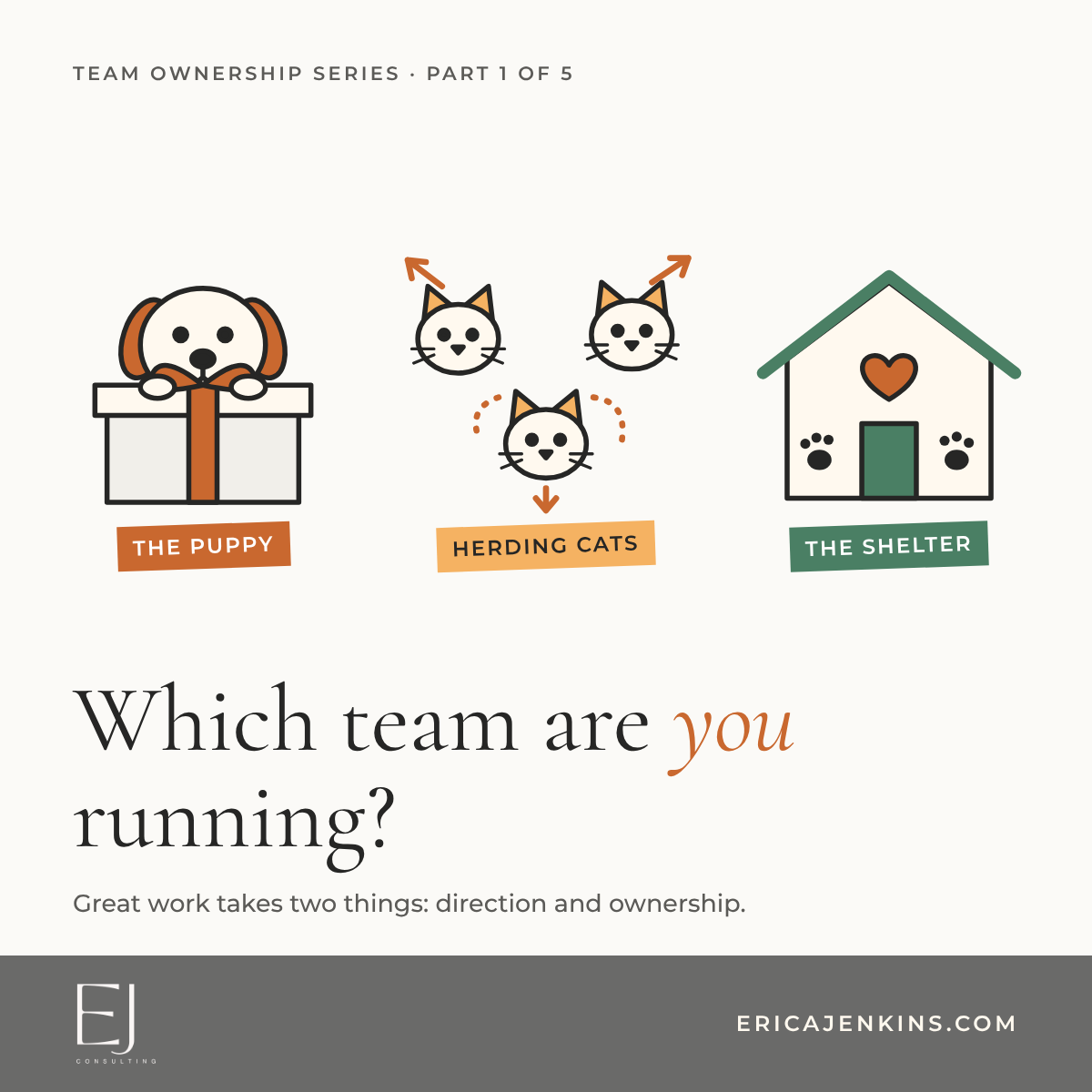
Why don’t teams take ownership of their work?
Teams don’t take ownership of work they had no hand in shaping. Quite honestly, they can’t own work that has no clear direction either. Nearly every stalled team I walk into has one of those two problems, and they need very different fixes.
I explain it with a playful mental visualization for all of us. Stay with me.
Say you hand someone a puppy. They never asked for a puppy. Maybe they wanted a kitten and you gave them a puppy. They’ll feed it. They’ll keep it alive, because you told them to. But it won’t thrive, and neither will they. That’s what happens when a project lands on someone’s desk from the top with a bow on it.
Now picture a team building an animal shelter program together. Everybody brings their expertise and strengths to the project. Everybody knows why it exists. Nobody has to be told to care, because it’s already theirs to bring to fruition.
And then there’s the third team, the one I see just as often. I call it herding cats. Every one of them is busy. Every one of them is headed somewhere. No two are going the same way.
These are real teams. I’ve walked into a marketing team with 14 initiatives in one quarter and no goal. I’ve sat in a pricing project where 15 people met for months without a decision. And I’ve watched a whole company get behind nine months of hard technical work, because everybody understood why it mattered. I’ll tell all three stories in this series.
What does a team need to do great work?
A team needs two things to do great work: direction and ownership. Direction is two or three clear objectives that everyone can name. Ownership is people who helped shape the work and want to see it succeed.
Take one away and you’ve got a problem. Which problem depends on which one you took.
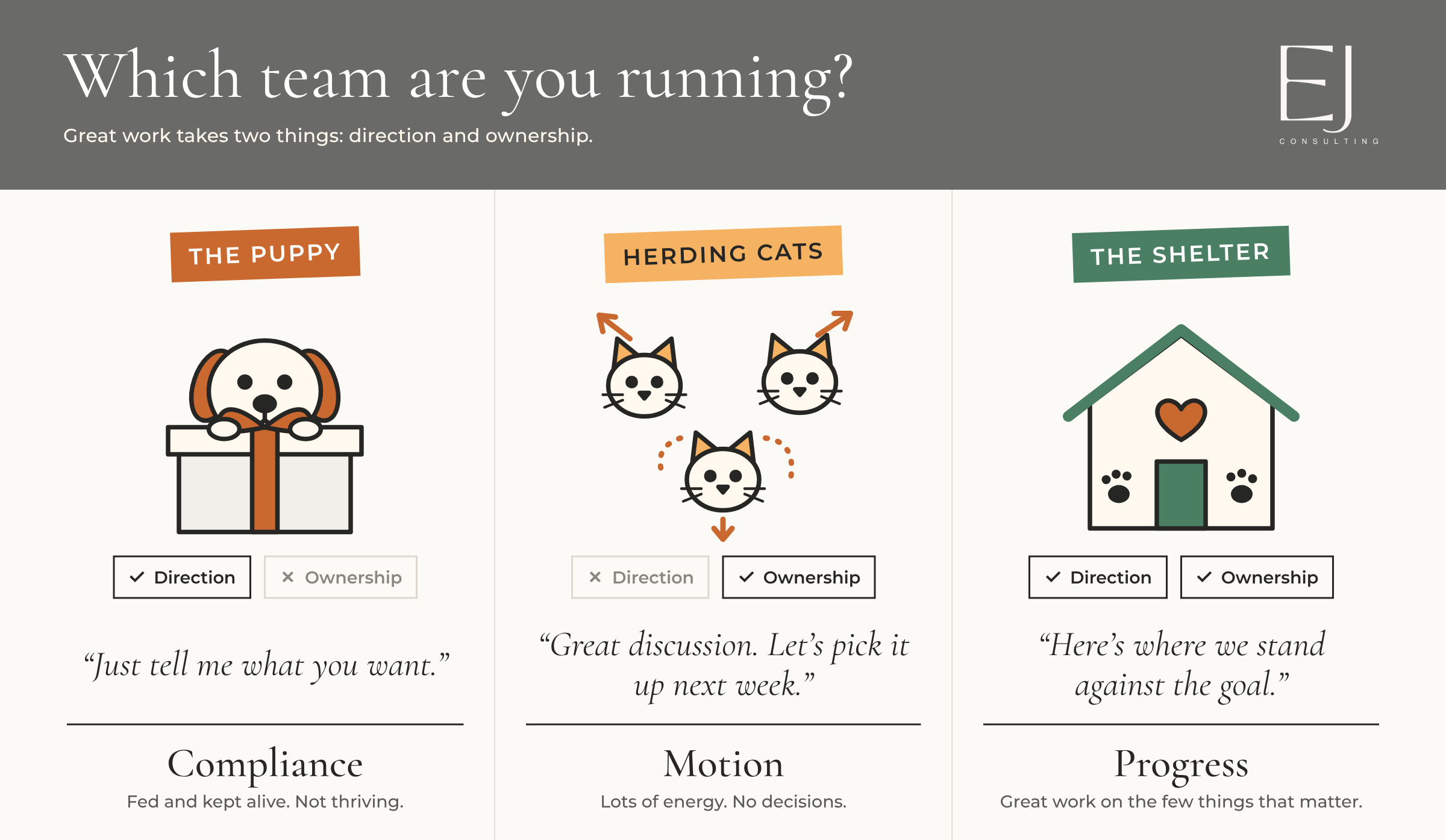
See this comparison as a table
| Team | Direction | Ownership | What it sounds like | What you get |
|---|---|---|---|---|
| The Puppy | Yes | No | “Just tell me what you want.” | Compliance. The work is done to the letter and no further. |
| Herding Cats | No | Yes | “Great discussion. Let’s pick it up next week.” | Motion. Plenty of energy and no decisions. |
| The Shelter | Yes | Yes | “Here is where we stand against the goal.” | Progress. Great work on the few things that matter. |
Which team are you running?
Most teams are a mix. Part Puppy, part Herding Cats, with one corner of Shelter where a good manager has quietly been doing it right all along.
The Puppy Syndrome Team Check takes about ten minutes. You’ll answer 15 statements, see what your meetings without an outcome cost you each year, and walk away with one place to start on Monday.
Next in the series: the Puppy, and a marketing team with 14 initiatives and no answer to “for what purpose?”
Frequently asked questions
What are the three kinds of teams?
The Puppy has direction without ownership. Herding Cats has ownership without direction. The Shelter has both, and it’s the only one that moves the business forward.
What is the puppy syndrome?
The puppy syndrome is what happens when a leader hands someone a project they had no part in choosing. The person does what they were told and nothing more, the way you would feed a puppy you never asked for.
Is top-down leadership always a problem?
No. The leader should set the destination. The trouble starts when the leader also hands down the route, the steps and the answers, and leaves the team nothing to contribute.