
Insights · Team ownership series, part 3 of 5
Herding Cats: Why Your Team Can’t Make a Decision
Why can’t my team make a decision?
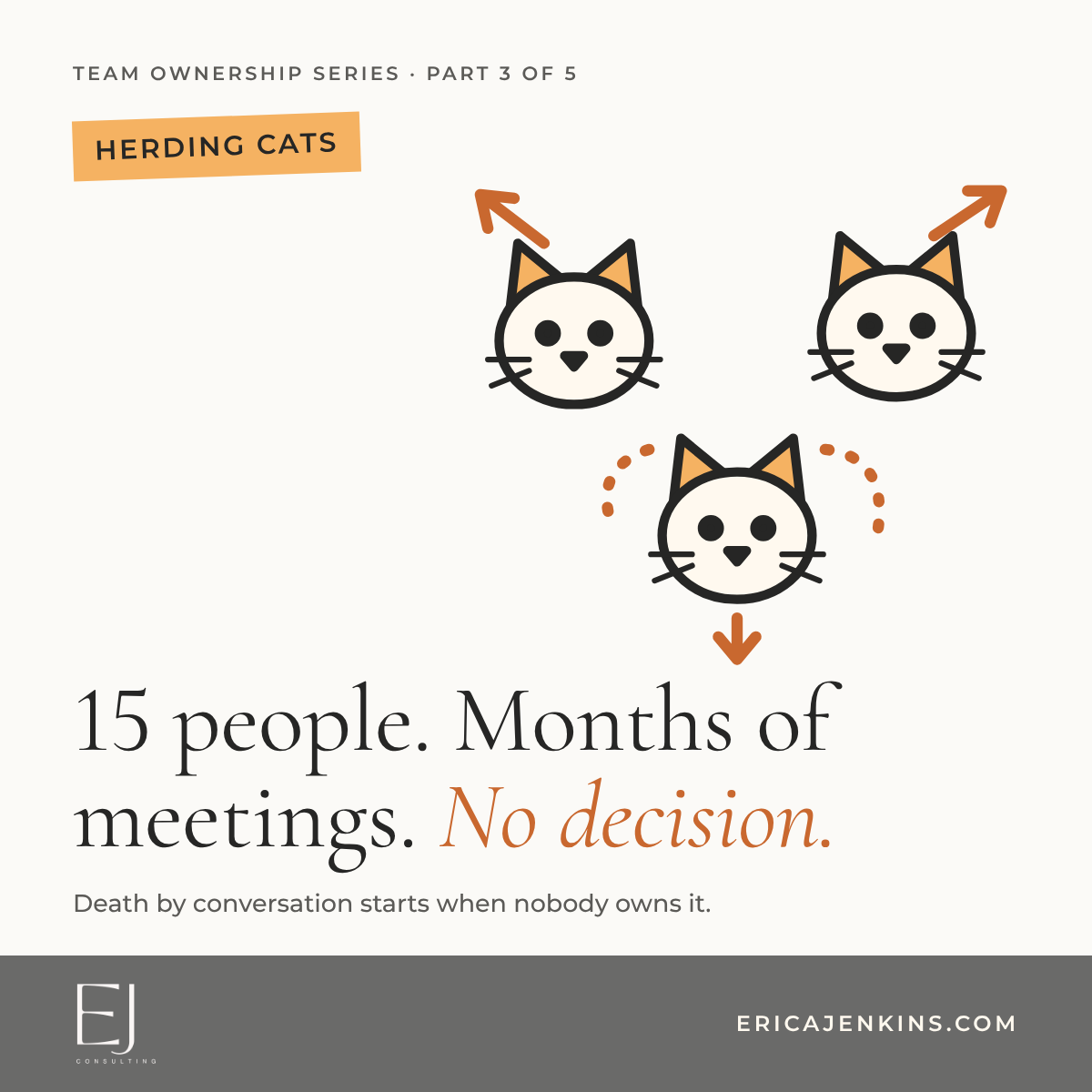
A team that can’t make a decision usually has no shared objective to decide against. Without one, every idea is as good as every other idea, and the debate never ends. I call it death by conversation. Herding cats is the team. Death by conversation is what it feels like to be on it. The root cause tends to be the same: nobody owns it. It’s the old saying about the single wringable neck. When there isn’t one, the conversation just keeps going.
Picture trying to herd cats. Every one of them is busy. Every one of them is headed somewhere. No two are going the same way, and not one is going where you need the group to go. And they’re all perfectly happy about it.
You’re probably herding cats if:
- Nobody can tell you who owns the decision.
- The same topic has been on the agenda for weeks.
- Meetings end with “let’s take that offline.”
- You have ten priorities, which means you have none.
- Everyone is busy and nothing is finished.
Herding cats fools a lot of leaders, because it looks healthy. People are engaged. They have opinions. The calendar is full. But busy isn’t the same as building. Looking busy is actually a flaw. Patrick Lencioni makes the point that debate is only useful when it ends in a commitment. When you’re herding cats, it never does.
What does death by conversation cost?
I lived this one. For a year I was the fractional chief product officer, a part-time executive embedded with the team, at a company in the middle of a pricing and packaging exercise. It had been going on before I got there.
Picture up to 15 people in a room, from all different parts of the business. Some had been at the company 15 years or more. Others had come from competitors. There were hours of presentations and calculators, people digging through old customer contracts, and meetings upon meetings for months.
There was no clear owner. There was also a technology knowledge gap: people didn’t understand how the product was structured, so they couldn’t see the different ways it could be packaged. It was just people in a room, having a conversation about a very important topic.
Death by conversation is really expensive. I don’t even want to guess what one of those meetings cost, but I’d put it at $100,000 or more of employee time spent on pricing and packaging conversations alone, with no outcome.
How do you end death by conversation?
You make an owner. Who’s going to own this and get it across the finish line?
That was my recommendation, and the CEO came in and said, “Stop all of the meetings.” A clear quarterly deliverable went to me and one other person on the team. We did the research, externally and internally. We learned the business and the costs, looked for where the profitability was and where the human capital was, and came back with a formal proposal.
We also built a playbook that explained why we’d come to these decisions, how they put us against our competitors, and how we’d be strong in the enterprise space. And we refused to go down into a smaller price point. Our product wasn’t ready, we weren’t self-serve, and we were an enterprise system.
After the initiative was complete, an employee took it over and became the internal expert. They took it forward, and it’s now adopted company-wide as their standard pricing. Of course, with any enterprise software there are adjustments for very specific cases. But generally speaking, sales had something to pitch off of. Before, they had to go back to a deal desk, the team that approves custom pricing, and that could take weeks. Far more efficient.
What are your meetings costing you?
The Puppy Syndrome Team Check includes a calculator. Put in your team size and your meeting hours, and it shows what meetings without an outcome cost you each year.
Next in the series: the Shelter, and what it looks like when a whole company understands why the hard work matters.
Frequently asked questions
Why does my team debate everything and never decide?
A team debates without end when it has no shared objective to decide against. Agree on two or three objectives first, and give each one an owner. Then each debate has a simple test: which option moves an objective?
What does “single wringable neck” mean?
It’s an old saying for one accountable owner. One person owns the decision and gets it across the finish line, pulling in the key stakeholders along the way.
How much do meetings without an outcome cost?
More than most leaders guess. Multiply the people in the room by the hours and by what their time costs. The Team Check calculator does that math for your own team.