
We Didn’t Change the Product. We Changed the Story.
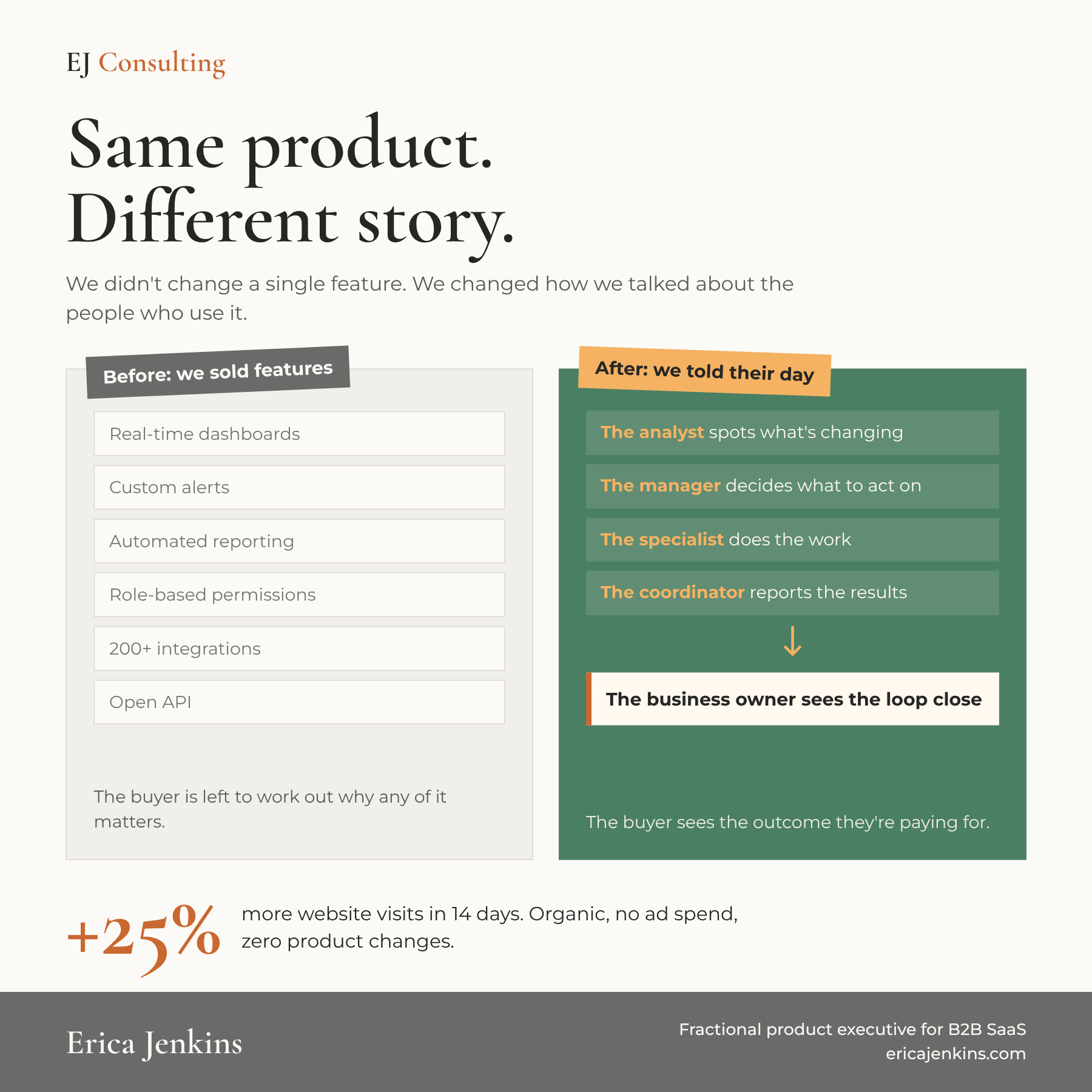
Most B2B SaaS companies I work with don’t have a product problem. They have a story problem. They’re explaining how the product works, when what the buyer really wants to know is why it matters to the people who use it every day.
I was reminded of this on a recent project. I was redoing a website with a client, and the whole engagement was about positioning. We didn’t add a feature or change pricing. We changed how we talked about our customers’ problems, and within 14 days of the new site going live, website visits were up more than 25%, without spending a dollar on ads.
I want to walk through how we got there, because AI played a big part in it, and probably not in the way you’d expect.
How did AI change the competitive research?
I already knew how the product suites compared to each other. Feature to feature, we held up well. What I didn’t know was how the competitors went to market. How did they talk about problems? How did they talk about themselves? Where did everyone sound the same?
Quite honestly, that kind of research used to take me months. Reading every website, every case study, every webinar description, and then trying to find the pattern across all of it.
This time I used Claude as my research partner, and in about two hours I really understood the competitive positioning landscape. Not a list of features, but a picture of the language, the claims and the gaps.
What did we find?
What we found was an opportunity to lean into the day in the life of the users.
This client had four different user archetypes. Those roles didn’t all see the same features and functionality. But everything they touched created a workflow that ultimately closed the loop for the business owner, who was our decision maker.
The decision maker didn’t care about any one feature. They cared that the loop closed. So we reframed the website away from features and around those four people, their days, and how their work came together into an outcome the business owner could see.
What happened when the new site launched?
Within the first 14 days, website visits were up more than 25%, and impressions rose too. That was all organic. We weren’t spending money on ads. It was a natural lift, because people started engaging with the website instead of bouncing. It finally spoke to their problems.
We didn’t change a single thing about the product. We changed how we talked about people’s problems, and that was transformational.
Why do so many SaaS companies end up selling features?
Because they build things in silos. Marketing doesn’t understand the problems. Product is too focused on the tech and how it works, not why it matters. Sales fills the gap with whatever closed the last deal.
I see this same problem in many different types of companies, whether it’s a martech company, a big data platform or a consumer app for field services teams. It’s a fundamental flaw in a lot of organizations, and it’s one of the first things I come in to help unpack and teach.
How do you use AI as a thinking partner instead of a replacement?
My point on AI is that it’s extremely powerful if you know how to use it as a partner. It doesn’t replace your thinking. It challenges it. When I run this kind of analysis, I’m working through four questions:
- What makes you different? Not in features, in outcomes.
- Where’s your white space? What problem is nobody in your market talking about?
- Where are you the same? Be honest, because sameness is where deals go to price.
- Where’s your power? What can you say about why someone should choose your product that nobody else can say?
AI helps me get to the answers faster and see around corners I can’t see on my own. What to do with those answers still comes from 20+ years and 30,000+ hours of leading product and go-to-market.
How quickly can a fractional product executive make an impact?
This is the part that matters most for the companies I work with. Most new executives need a six-month ramp-up before they can really change anything. Quite honestly, I need about two weeks. From there, we can start making change in the business.
That’s the power of pairing hands-on experience with AI. You get a leader who spends the quarter delivering instead of learning.
Frequently asked questions
Do you need to change your product to improve your positioning?
Often, no. In this project the product stayed exactly the same. The story changed.
How long does AI-assisted competitive research take?
For a focused market, a few hours to get a clear picture, compared with months of manual research. Human judgment still decides what to do with it.
What is a fractional product executive?
A senior product leader who joins your team for a defined set of goals and a set timeframe, usually a couple of days a week, and works with the same intensity as a full-time hire.