
Insights · Team ownership series, part 5 of 5
How Many Objectives Should a Team Have?
How many objectives should a team have at one time?
Two or three. Never ten. Focus, focus, focus. That’s my opinion after more than 20 years in software, and you won’t talk me out of it.
You cannot do ten objectives at one time. As a manager, you can’t oversee that many streams of work, take part in them, and make sure everybody is getting what they need along the way. Something gets dropped, and it’s usually the people.
Businesses move forward with great work being done, not lots of work being done. When everything is a priority, each person quietly picks their own, and you’re right back to herding cats.
Here’s a quick way to find out where you stand. Ask each person on your team to write down the team’s objectives without looking them up. If their answers don’t match, the team isn’t aligned yet, no matter what the planning deck says.
How do you get a team aligned and keep it aligned?
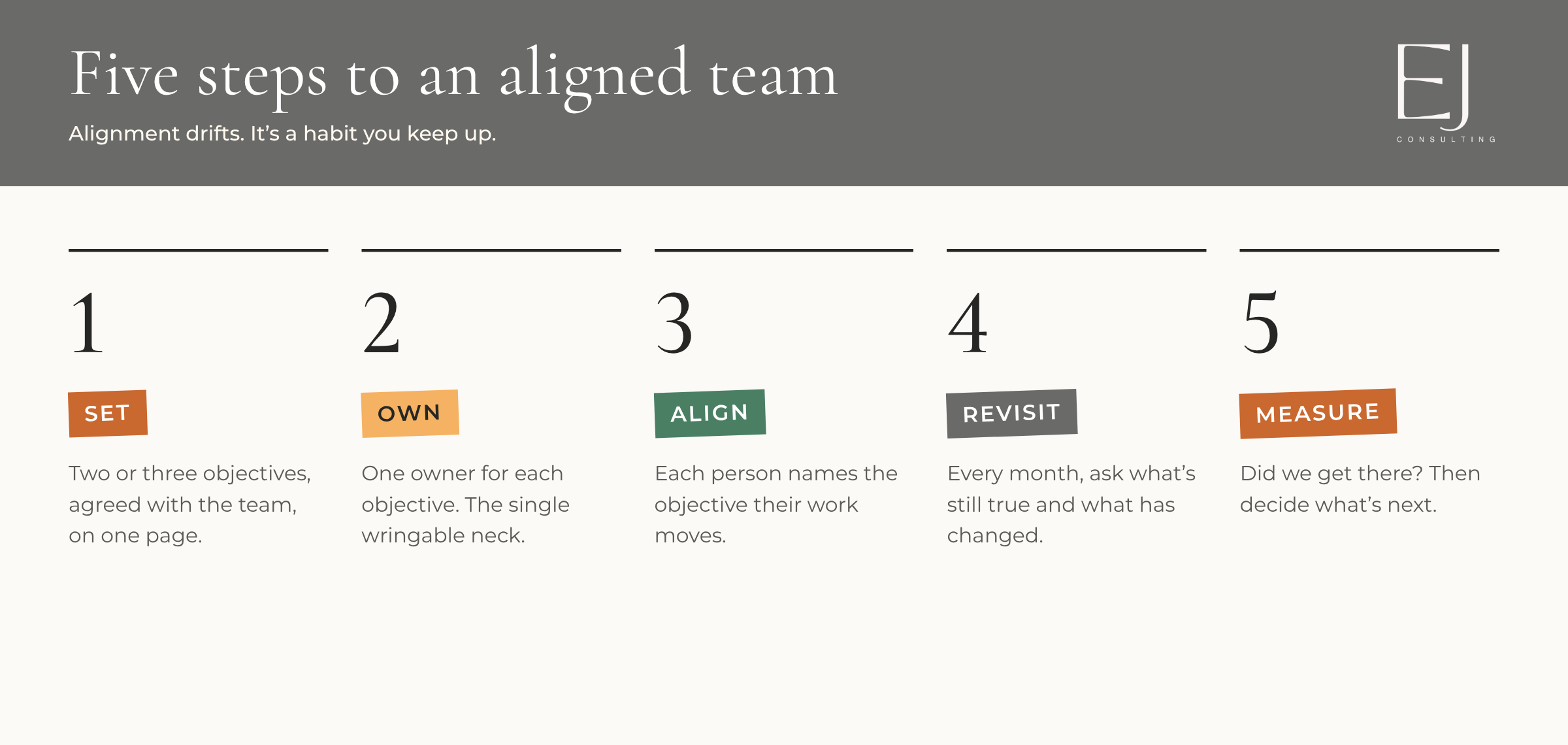
You set a few objectives together, give each one an owner, tie every person’s work to one of them, and keep coming back to check. Alignment drifts. It’s a habit you keep up, and one kickoff meeting won’t do it.
- Set. Paint the picture before you build it. Bring the team the problem before you have a plan, agree on two or three objectives for the quarter, and get them on one page.
- Own. Give every objective one owner, the single wringable neck. The owner doesn’t do it alone. They pull in the key stakeholders and get it across the finish line.
- Align. Each person says which objective their work moves and which piece they own. Work that moves none of them is your next conversation.
- Revisit. Put the page in front of the team every month. Ask what is still true and what has changed.
- Measure. At the end, answer one question honestly: did we get there? Then decide what’s next.
Your meetings carry all five steps. Every one needs an agenda going in, and decisions, owners and dates coming out. Otherwise it’s just a conversation with a calendar invite.
Which team are you running?
This series started with a puppy nobody asked for, moved on to herding cats, and ended at the shelter everyone built together. Most teams are a mix of all three.
The Puppy Syndrome Team Check takes about ten minutes. You’ll answer 15 statements, see what your meetings without an outcome cost you each year, and walk away with one place to start on Monday.
Frequently asked questions
How many objectives should a team have?
Two or three at a time. A manager cannot oversee more than that and still take part in the work and support the people doing it.
How often should a team revisit its objectives?
Every month. Put the one-page objectives in front of the team and ask what is still true and what has changed.
What should every meeting produce?
Decisions, owners and dates. And it needs an agenda going in, so people know what they’re there to decide.