
Before You Rush a Full-Time Executive Hire, Read This

An empty seat at the executive table creates a lot of pressure. The board wants it filled. The team needs direction. Customers are noticing. So companies do what feels responsible: they rush a full-time search.
I’ve watched what happens next more times than I can count. Six to 12 months later, that person leaves, or it becomes clear they weren’t the right person from the get-go. Now you’re back where you started, except you’ve lost a year, the team is more unsettled than before, and you’re paying for another search.
There’s a better way to fill the gap, and it works whether you’re a CEO with an open seat or a private equity firm looking after a portfolio.
Why do so many executive hires go wrong?
Quite honestly, it usually isn’t the candidate’s fault. It’s that the company was hiring before it knew what it needed.
When a leader leaves, nobody has had the time to step back and diagnose the business. So the job description gets written from the old org chart, or from the résumé of the person who just left. You end up hiring for the role you had, not the problem you have.
Add the urgency, and you get a fast decision on a fuzzy brief. That’s an expensive combination at the executive level.
What does a fractional or interim executive do differently?
A seasoned operator sits in the seat now. They keep the business on the rails while you take the time to hire the right person.
I need about two weeks to ramp. In those first weeks, I’m in essence interviewing your employees, watching sales calls and looking at the product as if I’m an outsider. From there, I bring forward the low-hanging fruit and the bigger changes that need to happen, so the business keeps moving instead of waiting.
The difference is that I’m not trying to keep the job. My goal is to leave you with a stronger team and the right permanent leader.
Fractional executive vs. full-time hire: the pros and cons
Both have their place. Here’s how they honestly compare when you have a gap to fill.
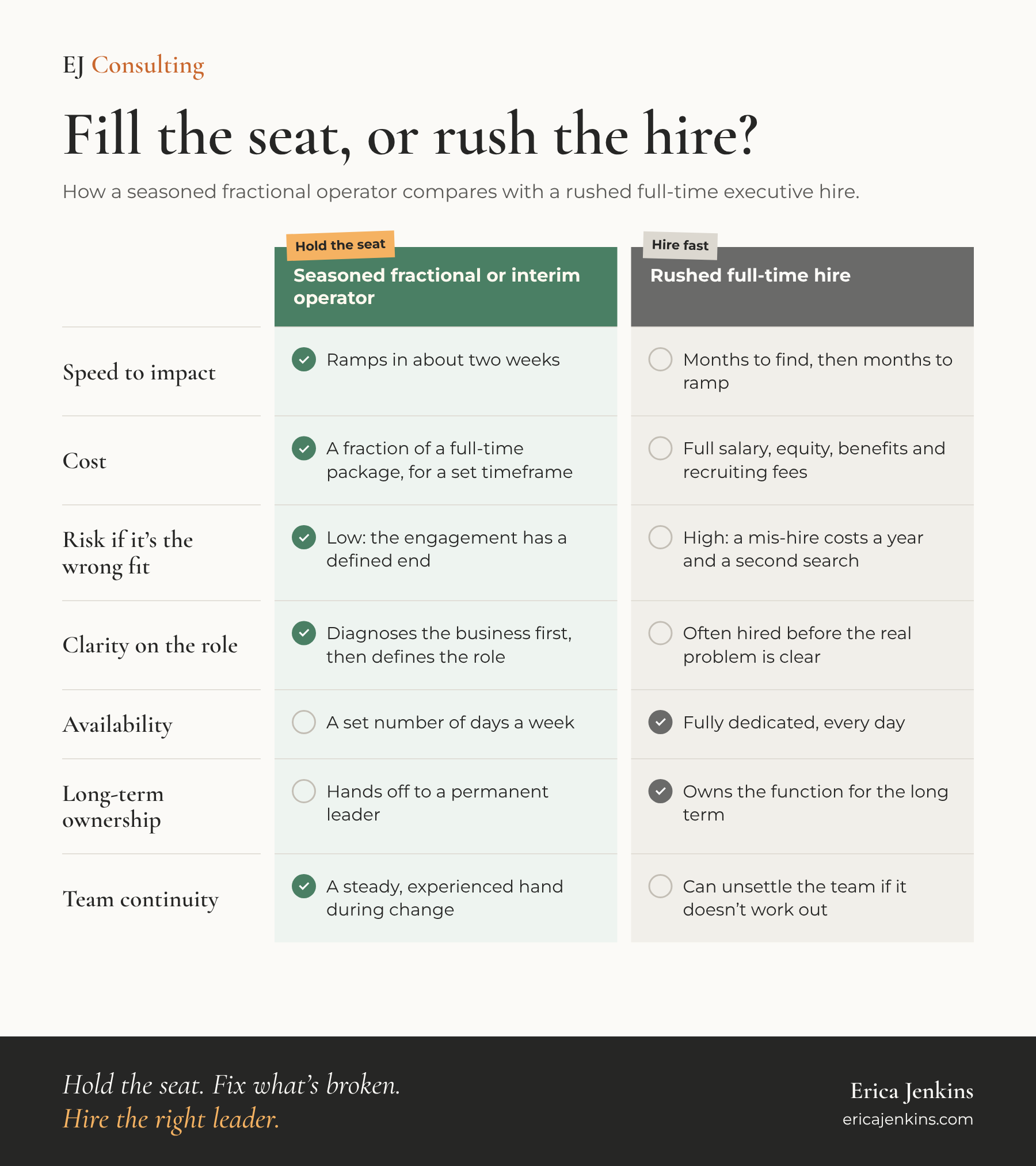
See this comparison as a table
| Factor | Seasoned fractional or interim operator | Rushed full-time hire |
|---|---|---|
| Speed to impact | Ramps in about two weeks | Months to find, then months to ramp |
| Cost | A fraction of a full-time package, for a set timeframe | Full salary, equity, benefits and recruiting fees |
| Risk if it’s the wrong fit | Low: the engagement has a defined end | High: a mis-hire costs a year and a second search |
| Clarity on the role | Diagnoses the business first, then defines the role | Often hired before the real problem is clear |
| Availability | A set number of days a week | Fully dedicated, every day |
| Long-term ownership | Hands off to a permanent leader | Owns the function for the long term |
| Team continuity | A steady, experienced hand during change | Can unsettle the team if it doesn’t work out |
The honest trade-off: a fractional leader isn’t with you every day. When I stepped in as interim president during a CEO change, I was still there two days a week, and I didn’t get as much done as I would have liked. But the business stayed on the rails, the product strategy kept moving, and the team had a familiar face while the board found the right CEO.
When should you hire full-time right away?
If you know exactly what the role needs to deliver, the business is stable and you have a strong candidate in hand, go hire them. A fractional leader isn’t a reason to delay a great hire.
But if the seat opened unexpectedly, if the business is in transition, or if you’re not sure the old job description still fits, that’s when an interim operator pays for itself.
How can a fractional leader help you hire the right person?
This is the part most companies don’t expect. Because I’m inside the business, I can help you hire better than a search alone:
- Define the role from the real problem. After diagnosing the business, I can tell you what this leader actually needs to fix in the next 12 to 18 months.
- Build the scorecard. Clear outcomes and must-have experience, so candidates are measured against what matters.
- Interview as an operator. I can tell the difference between someone who’s managed this kind of work and someone who’s done it.
- Onboard and hand off. The new leader inherits a working plan and a team that’s already moving, instead of a mess and a blank page.
Why do private equity and growth equity firms use fractional operators?
For investors, a leadership gap in a portfolio company is expensive, and it’s often the first thing that shows up after a deal closes. A founder steps back, a key leader leaves, or the team that got the company here isn’t the team that gets it to the next stage.
I serve as an operating and sector expert with two private and growth equity teams. One of them is Metropolitan Partners Group, where I’m an Operating Expert in ONE, its network of more than 600 operators and functional experts. MetPG brings me into due diligence assessments alongside a top-tier team, and it has been genuinely supportive of my growth as a fractional, female-led firm.
That work includes helping assess B2B SaaS acquisitions in the $10M to $50M range, coaching executive teams after the deal, and building the repeatable processes that prepare companies for a strong exit. It’s no accident that operator networks like ONE engage experts through interim leadership, rapid diagnostics and hands-on enablement. That’s where operators move the needle.
What does this look like in practice?
Due diligence: is the story true? An investment firm was evaluating a martech company. A technology expert and I came in to assess the readiness of the product, the positioning, the personas and the feature set compared to the competition. Quite honestly, our job was simple to say and hard to do: make sure what the firm was being told was actually true. We were advising the investment firm on a go or no-go decision based on the product and the tech.
M&A: who fits with whom? I’ve also been pulled in as a thought expert for portfolio reassessments, looking at which companies complement each other. Sometimes my client wanted to be acquired. Other times, they were looking to spend money alongside their private equity firm to buy another company. Either way, I’ve helped prepare for the process, whether that’s getting ready to sell or deciding what to buy.
Been there, done that: getting ready to be acquired. I’ve lived this from the other side of the table, too. Preparing my own company for two acquisitions meant getting our due diligence and data library together: the technical documentation, the architecture, the schema, all of it. When an acquirer comes in, it’s almost like a tax audit. They rapid-fire questions and want to know everything about your business.
We had toolkits ready. We were so organized and detailed about what our business did that it made it easy for them to pick us up and integrate us into their systems. The acquiring company told us that preparation drove our multiple up by at least 2x.
I know what investors and acquirers will ask, because I’ve had to answer it.
A fractional operator on your bench gives you someone who can come into a portfolio company for three to six months, diagnose what’s really going on, stabilize the leadership gap, and help you hire the right permanent executive. You get operating experience on demand, without adding to your firm’s headcount.
What does a three- to six-month engagement look like?
Every engagement is different, but it usually follows this shape:
- The first two weeks: immerse in the business. Interview the team, watch sales calls and review the product, the numbers and the customers.
- The first two months: diagnose and stabilize. Act on the low-hanging fruit and agree on the bigger changes.
- Months two to four: fix with the team, while defining the permanent role and running the search with you.
- Months four to six: onboard the new leader, hand off the plan and leave the team stronger.
It’s “Fractional in title, full time on impact,” as one of my clients put it, with a clear finish line.
Frequently asked questions
What is the difference between a fractional and an interim executive?
An interim executive temporarily holds a specific seat until a permanent hire is made. A fractional executive works part of each week, often for a longer period. Many engagements are both: part-time, and holding the seat until the right person is hired.
How long does an interim executive engagement last?
Typically three to six months for a leadership gap or a portfolio company diagnosis, and longer when the work extends into ongoing fractional leadership.
Can a fractional executive help hire their own replacement?
Yes. Because they’ve diagnosed the business from the inside, they can define the role, build the scorecard, interview candidates and onboard the new leader.
Do private equity firms use fractional executives?
Yes. PE and growth equity firms use fractional operators to fill leadership gaps in portfolio companies, assess acquisitions and support executive teams after a deal, without adding permanent headcount.
What does an operator do in technical due diligence?
An operator checks whether the product, positioning, personas and technology are what the company claims, compares the feature set to competitors, and advises the investor on a go or no-go decision.
How do you prepare a SaaS company for acquisition?
Build your due diligence library before you need it: technical documentation, architecture, data schema, processes and key metrics. When buyers can quickly understand and integrate your business, it can raise your valuation.
What does a fractional executive cost compared to a full-time hire?
Fractional engagements are usually priced by time commitment for a set timeframe, and typically cost a fraction of a full-time executive once you add salary, equity, benefits and recruiting fees.